When is golden hour, and how long does it last?
Golden hour is the time just after sunrise and just before sunset, when the sun is low and the light goes warm and soft. In London it lasts from about 45 minutes to an hour, depending on the time of year, and blue hour comes after sunset, once the sun has gone and the sky turns a deep blue.
The box above works it out for your part of the world, or anywhere you pick. Go a long way north or south and the times change a lot. Near the equator golden hour is over in half an hour, and in the far north in winter the sun can stay low all day.
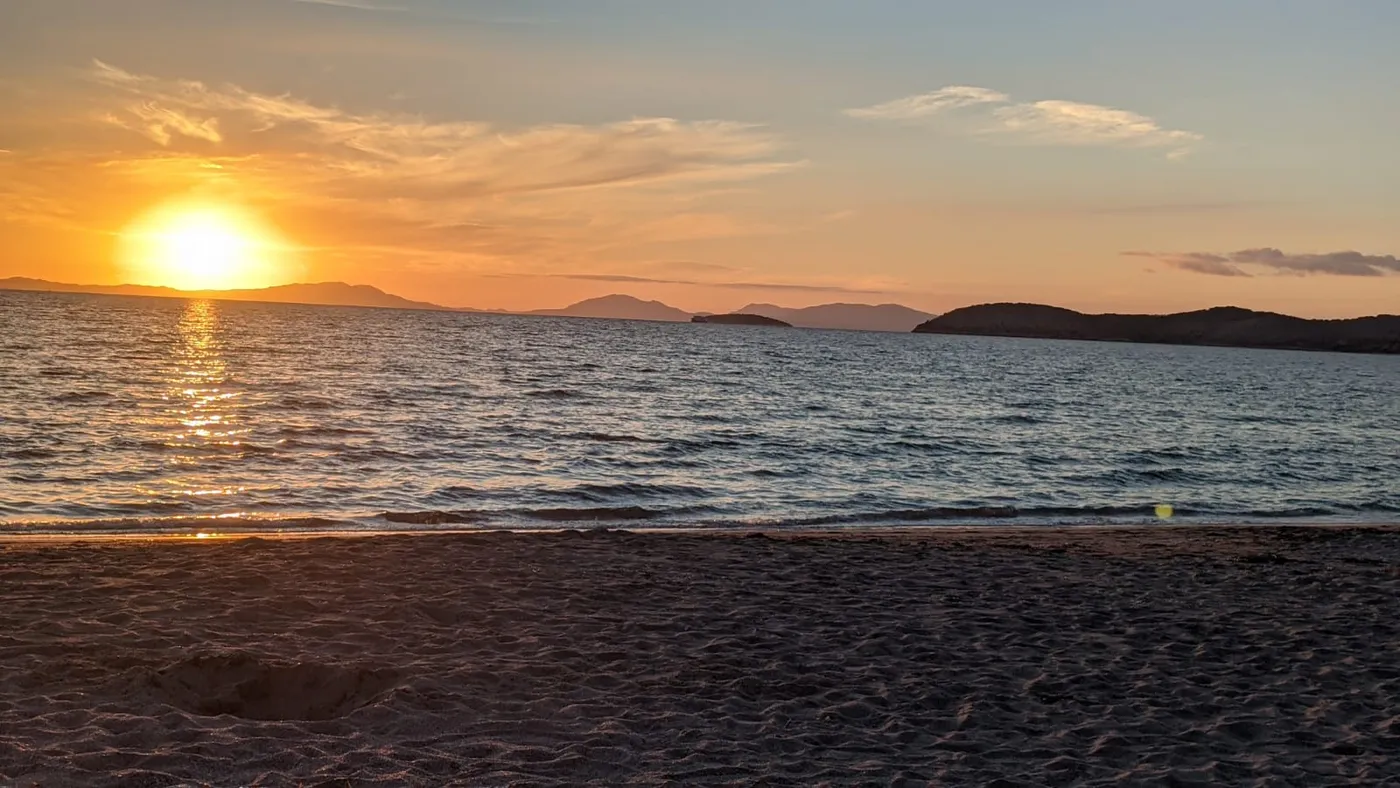
Header photo: sunset at our first campsite in Greece, on our bike ride from the UK to Georgia.
How long golden hour lasts
Golden hour is rarely an hour. How long you get depends mostly on how far you are from the equator. Near the equator the sun drops almost straight down, so it passes through the low part of the sky quickly. Further north or south it sinks at a slant and takes its time.
Quito, almost on the equator, gets about half an hour of golden light at each end of the day, all year round.
In London it's between 45 minutes and an hour. Oddly, it's longest in midwinter, when the days are shortest, and shortest around March and September.
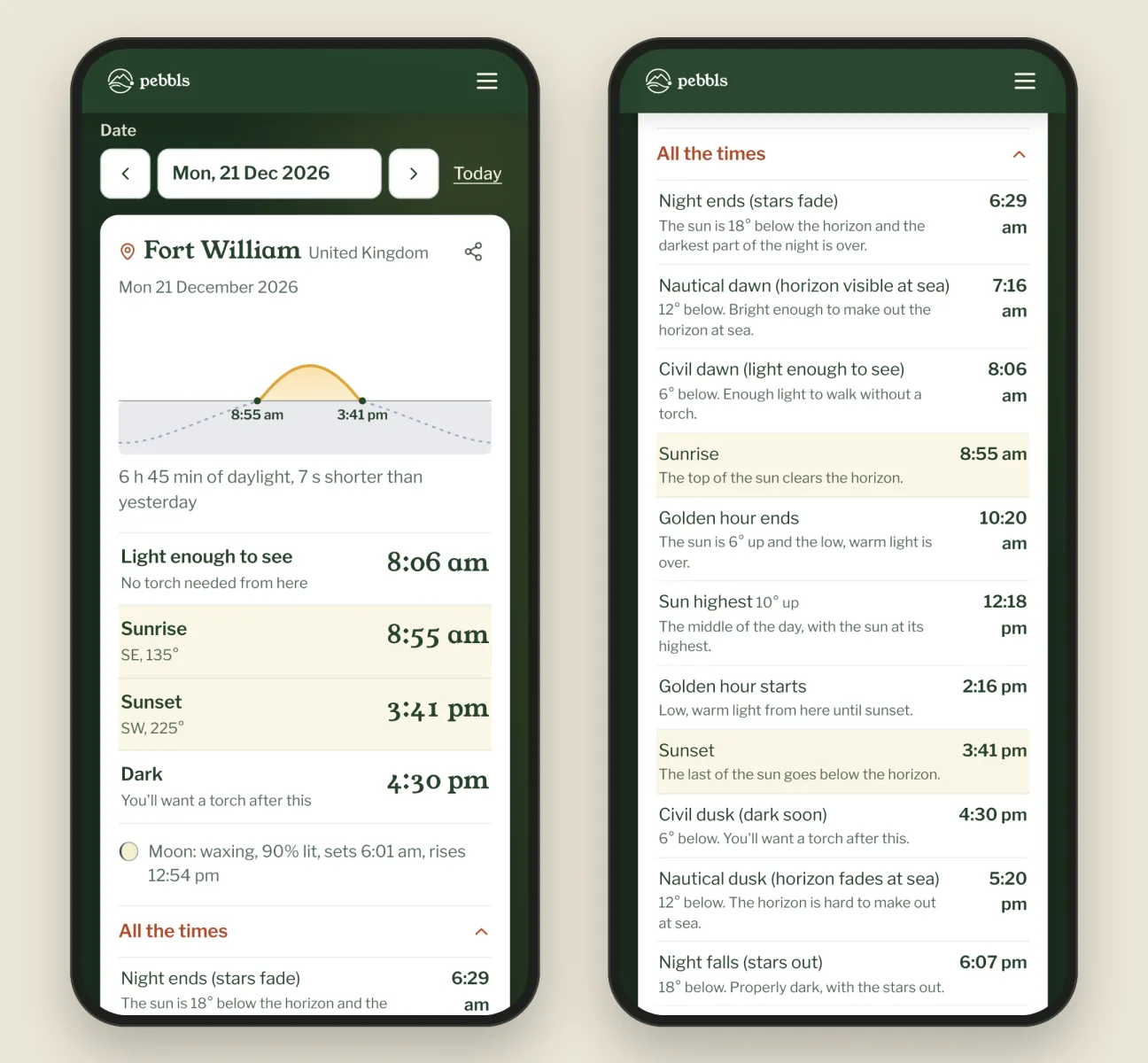
In the Scottish Highlands the winter sun never gets far above the horizon. On the shortest day in Fort William it rises at 08:55 and sets at 15:41. Golden hour lasts until 10:20 and starts again at 14:16, so you get almost three hours of golden light in a day under seven hours long.
Further north it gets stranger. In Reykjavik on 21 December the sun is up from 11:22 to 15:29 and never climbs high enough to leave golden hour. In June it sets just after midnight, and golden hour lasts nearly two hours at each end of the day. In Tromsø the sun doesn't set at all from the middle of May to late July, and there are hours of golden light around midnight.
The southern hemisphere is the same with the seasons swapped, so in Sydney and Cape Town the longest golden hours come around June. Even then they're under 40 minutes.
Golden hour times for some well-known places
These are the evening golden hours on 21 December and 21 June, in each place's local time, from our sunrise and sunset tool. The morning one is the same length. Tap a place for any other day.
| Place | 21 December 2026 | 21 June 2027 |
|---|---|---|
| London | 14:51 – 15:53 | 20:27 – 21:21 |
| Edinburgh | 14:20 – 15:39 | 20:58 – 22:02 |
| Amsterdam | 15:24 – 16:28 | 21:10 – 22:06 |
| Lisbon | 16:36 – 17:18 | 20:24 – 21:04 |
| Reykjavik | Low sun all day, 11:22 – 15:29 | 22:06 – 00:03 |
| Marrakech | 17:55 – 18:32 | 20:04 – 20:40 |
| Kyoto | 16:09 – 16:48 | 18:36 – 19:14 |
| Sydney | 19:28 – 20:05 | 16:15 – 16:53 |
| Cape Town | 19:19 – 19:56 | 17:06 – 17:44 |
| Quito | 17:46 – 18:16 | 17:49 – 18:19 |
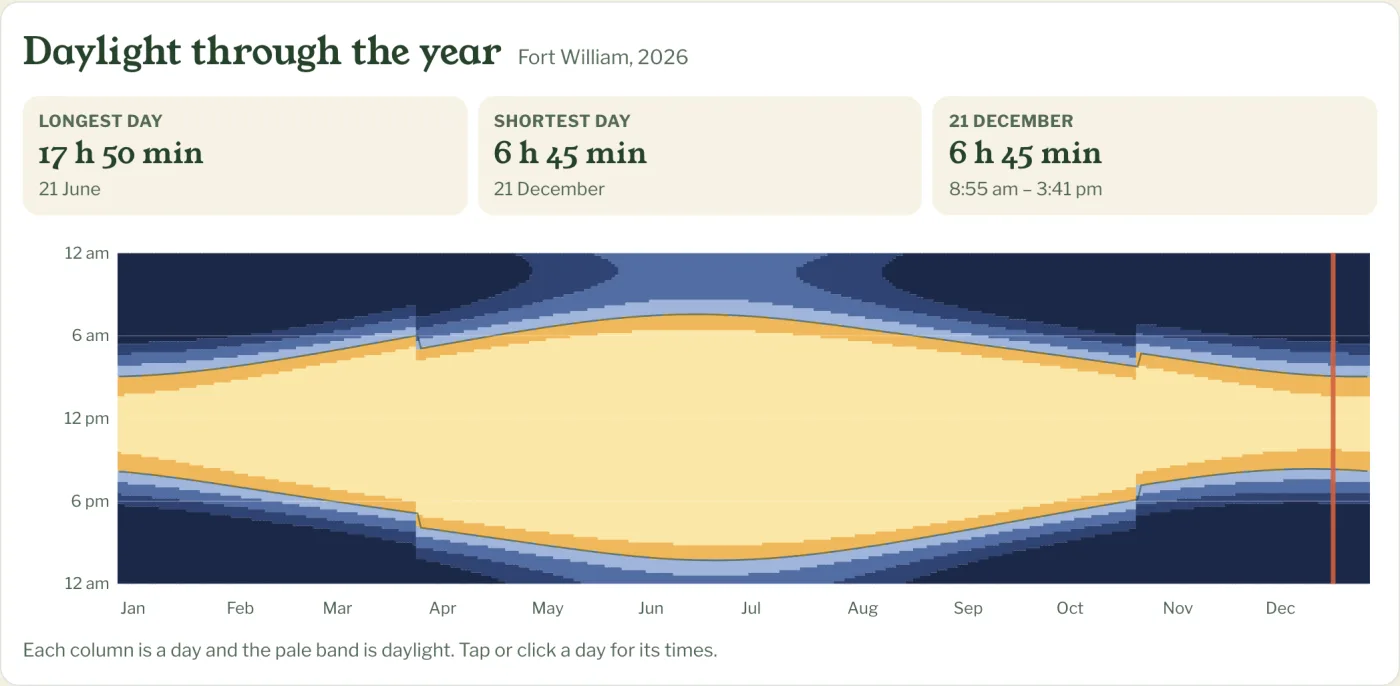
The tool also draws a whole year for a place on one chart, so you can see the light change with the seasons.
When blue hour is
Blue hour is the short spell after sunset when the sun has gone but there's still light in the sky, and everything turns a deep, even blue. There's one before sunrise too. It's the time for city lights and lit windows against a dark blue sky.
In London it starts about 25 minutes after sunset and lasts 15 to 20 minutes. Near the equator it's over in under ten minutes. In Scotland in summer it's nearly half an hour, and around midsummer in Iceland the sky never gets dark enough for one.
When blue hour ends, so does the last of the daylight. Out on a path, that's when the head torch comes out.
Tips for golden hour photos
Where to stand. With the sun behind you, faces and hills catch the warm light full on and the colours look rich. Turn to face it and you get silhouettes and a glowing sky, which works best with a strong shape against it, like a person or a lone tree. With the sun off to one side, the long shadows pick out every bump in the ground, and that's often the best way to show hills, dunes and old stone walls.
Be set up early. The light gets warmer as the sun sinks, so the last few minutes before sunset are usually the most golden. A bank of cloud on the horizon can take the sun away before then, though, so be in place when golden hour starts.
With the sun in the picture, wait until it's just touching the horizon, or half hidden behind a hill or a tree, so it doesn't swamp everything else.
On a phone. Tap the screen on the bright part of the sky, then drag the brightness down a little so the sky doesn't turn white. Leave the flash off.
On a camera. Auto white balance tends to cancel out some of the warmth. Try the daylight (sunny) setting to keep the colours as you saw them, or shoot raw and decide later.
In blue hour there isn't much light. Most phones have a night mode for it: hold the phone as still as you can, or rest it on a wall. On a camera, use a tripod and a low ISO and leave the shutter open for a few seconds. Water goes smooth and car lights turn into streaks.
Planning a walk around the light
Work back from sunset. Find when golden hour starts for the place and the day, and be at the view by then. Allow for the walk up, and some time to faff with a camera.
Know when you'll need a torch. Once blue hour is over it's hard to see the path, especially under trees or on rough ground. If you stay up top for it, you'll be walking down in the dark, so pick a way down you know, and take a torch with spare batteries.
Mind the hills around you. The times in any calculator, ours included, are for a flat horizon. In a valley or under a ridge the sun goes behind the hill earlier, sometimes much earlier, and golden hour ends with it. On a summit you get all of it.
Tell someone. If the plan is to come down after dark, leave your route and the time you'll be back with someone who'll notice if you're late. Our hiking safety plan puts it on one page and in one link.
Using the sunrise and sunset tool
The sunrise and sunset tool gives you sunrise, sunset and golden hour for any place and day, and when it gets dark, all in local time. Places people often plan trips around have their own pages, Fort William and Tromsø among them. For a walk of several days, you can load the route and see whether each day ends before dark.
It doesn't have a blue hour row. The box at the top of this post does, and in Britain blue hour is roughly the last 15 to 30 minutes before the time the tool calls "Dark".
Quick answers
When is golden hour today? The box at the top of this post works it out for your place. In London it starts around 14:50 in late December and around 20:30 in late June, and ends at sunset. In the morning it starts at sunrise.
How long is golden hour? Rarely an hour. It's about half an hour near the equator and 45 minutes to an hour in London. In the far north it can last for hours, or all day.
Is there a golden hour in the morning? Yes. It starts at sunrise and lasts about as long as the evening one on the same day.
What time is blue hour? Just after sunset, and just before sunrise. In London it starts about 25 minutes after sunset and lasts 15 to 20 minutes.
Is golden hour the same as sunset? No. It's the time before sunset, and it ends when the sun goes below the horizon. The colourful sky after sunset is twilight, and blue hour comes near the end of it.
How we measure it
There's no official definition of golden hour or blue hour, so apps can differ by a few minutes. Ours, like many photography apps, counts golden hour as the time the sun is less than 6 degrees above the horizon. Blue hour is the sun between 4 and 6 degrees below it. At 6 degrees below, the last of the daylight is over (astronomers call this the end of civil twilight), and that's the time the tool calls "Dark".
The times are worked out in your browser, with the same method as the solar calculator of NOAA, the US weather and oceans agency.