John Muir Way
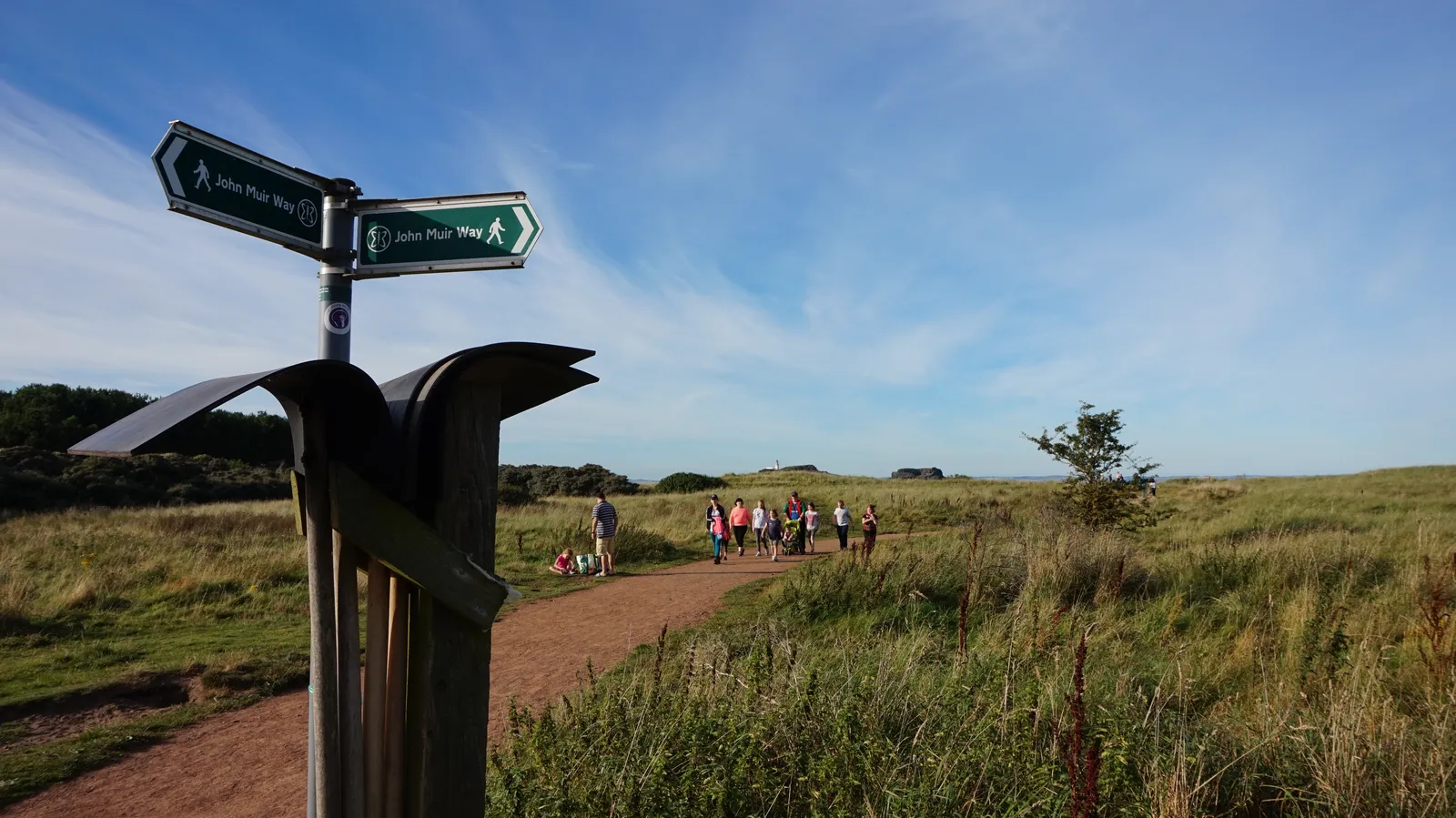
Photo: David Gilmour, CC BY-SA 4.0, via Wikimedia Commons
- Distance
- 215 km (134 miles)
- Country
- Scotland
- Difficulty
- Easy to moderate
- Type of trip
- Hiking trail
The John Muir Way crosses Scotland coast to coast, from Helensburgh on the Firth of Clyde to Dunbar on the North Sea. It opened in April 2014 and is named after John Muir (1838–1914), the conservationist who was born in Dunbar and helped found America's national parks. Scotland's Great Trails suggests 9 to 11 days for the whole thing, but plenty of people walk it in sections or as day walks using trains and buses. It isn't a wilderness walk. After the hills in the west it follows canal towpaths, country parks, towns and Edinburgh before the beaches and clifftops of the East Lothian coast. Gradients are mostly gentle, and the highest point is only 275 m, in the Kilpatrick Hills. It's waymarked all the way, with separate walking and cycling branches where they split. Scotland's Great Trails recommends walking it west to east, with the prevailing wind behind you and Muir's birthplace at the end.
There are no permits. B&Bs, hotels and inns are spread along the route, but there are no hostels or bunkhouses outside Edinburgh. Villages are further apart in the west, and Balloch to Strathblane is a long day of 29.3 km (18.2 miles) that some people split. Trains run from Glasgow Queen Street to Helensburgh and from Edinburgh Waverley to Dunbar, and there are plenty of stations between Falkirk and Dunbar. Further west there are fewer, but buses fill most of the gaps.
Highlights along the way
- Loch Lomond: The hills between Helensburgh and Balloch give views over Loch Lomond and the Trossachs National Park, Scotland's first national park. This is one of the wilder parts of the route, windswept moorland with little shelter.
- The Falkirk Wheel: From Kirkintilloch the Way follows the Forth and Clyde Canal to Falkirk, where the wheel, the world's only rotating boat lift, links the canals.
- The Antonine Wall: Before Linlithgow you pass the Antonine Wall and its forts, once the north-west frontier of the Roman Empire.
- Blackness Castle: Past Linlithgow and its palace, the Way reaches the shore at Bo'ness and Blackness Castle, which was used in the TV series Outlander. Further on, you pass the three Forth bridges at South Queensferry.
- Dunbar: The walk ends in the town where John Muir was born, after following the East Lothian coast by Aberlady and North Berwick. There's a museum dedicated to him.
Distance
215 km (134 miles), with about 2,015 m of climbing according to Scotland's Great Trails. In places the cycling branches are smoother and flatter, and walkers can use them too.
Best time to go
Scotland's Great Trails says that from April to September there's at least 12 hours of daylight, which helps on the long days. The hills in the west are windswept and exposed in bad weather. The route is looked after by ten councils and park authorities, and the John Muir Trust lists diversions they tell it about. In November 2026 that page had a notice from February 2026 about tree felling near Strathblane from spring to autumn 2026, with signed diversions, and one from January 2026 saying a diversion at the Dunbar end of the route is likely to stay for years. Check the diversions page on johnmuirtrust.org before you go.
More journeys in Scotland
- Scotland West Coast Train · Greg
- Cycling the Hebridean Way · Simon & Lucy
- The History of the Sea · saeunn
- Highland Adventure · Nick
- Christmas Ski Trip To Les Arcs · Peter
Flyby films from Scotland
- The Great Escape · saeunn
- Mallaig..and Train Back To Glasgow! · Greg
- THE ATLANTIC · SY
- Mallaig to Fort William · Simon & Lucy
More routes like this
- Fife Coastal Path · 188 km (117 miles) · Scotland
- Rob Roy Way · 128 km (79 miles) · Scotland
- West Highland Way · 154 km (96 miles) · Scotland
- Cape Wrath Trail · about 320 km (200 miles) · Scotland
- Pennine Way · about 431 km (268 miles) · England, Scotland
- Speyside Way · 137 km (85 miles) · Scotland