Norfolk Broads by kayak
- Distance
- Varies with your plan. For scale, the Broads have more than 200 km of navigable rivers and broads, and the Broads Authority’s canoe trails run from an hour’s paddle to a full day.
- Country
- England
- Difficulty
- Easy
- Type of trip
- Kayak & canoe
There’s no single paddling route through the Broads. It’s a paddling area: seven rivers and 63 broads (shallow lakes) in Norfolk and Suffolk, with more than 200 km of navigable water and only one lock, Mutford Lock at Oulton Broad. The broads aren’t natural. In the 1960s the botanist Joyce Lambert showed they’re medieval peat diggings that flooded as sea levels rose. Since the Norfolk and Suffolk Broads Act 1988 the area has been run by the Broads Authority, with protection similar to a national park. In 2015 the Authority started calling it the Broads National Park, though it isn’t a national park in law.
You need a licence to paddle. If you’re a member of Paddle UK (formerly British Canoeing), that covers canoes, kayaks and paddleboards on all Broads Authority waters. If not, you’ll need a Broads Authority short-visit or annual toll; check the current cost with the Broads Authority. Wear a buoyancy aid. You share the main rivers with hire cruisers and other motor boats, and you should stay away from the reed edges, where birds breed. The Broads Authority says the more tidal waters, such as the lower rivers near Great Yarmouth and Breydon Water, are only for paddlers who are extremely experienced and fit. The Trinity Broads (Ormesby, Rollesby, Filby and their neighbours) look tempting but are privately owned, not connected to the rest of the network, and closed to all paddle craft.
Highlights along the way
- Canoe trails: the Broads Authority publishes trail maps for short paddles and day trips. Among them are Wayford Bridge and Sutton on the upper River Ant, Salhouse Broad, Norwich to Rockland and Rockland to Loddon on the Yare and Chet, and Geldeston and a Bungay loop on the River Waveney.
- Hickling Broad: the largest broad, in a Norfolk Wildlife Trust reserve of about 600 ha with England’s largest reed bed. Bitterns and marsh harriers are here for most of the year, and cranes visit in winter. The navigation channel is only 1.5 m deep.
- Ranworth: a village beside Malthouse Broad, off the River Bure. St Helen’s Church, called "the Cathedral of the Broads", has a 15th-century painted rood screen and a tower about 30 m high that you can climb for views across the broads.
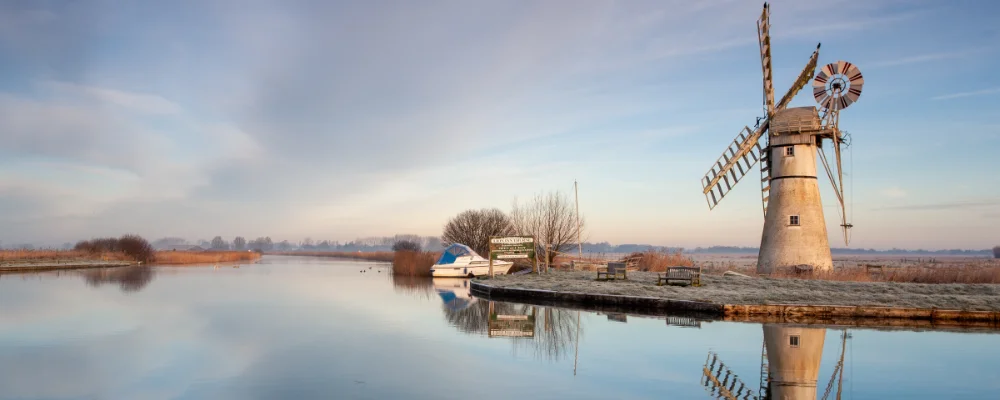
- Thurne Dyke: where a short dyke meets the River Thurne, with a white drainage windpump at its end that photographers come for. The Lion Inn is in the village.
- Wildlife from water level: paddling is quiet, so you get closer to water voles, great crested grebes and sometimes otters than you would from a cruiser.
Distance
Varies with your plan. For scale, the Broads have more than 200 km of navigable rivers and broads, and the Broads Authority’s canoe trails run from an hour’s paddle to a full day.
Best time to go
April to September, for longer days and warmer weather. Outside those months the birdlife at Hickling is still worth the trip, but dress for cold water and check that the hire centres are open.
More journeys in England
- Exmouth towards Poole SWCP · Greg
- Folk on a Boat · Simon & Lucy
- Bristol Rides · David
- Scotland West Coast Train · Greg
- Week In UK · Greg
- Pangbourne · Ben
Flyby films from England
- Kenya safari · Alison Popper
- The Great Escape · saeunn
- Ferry to UK · Greg
- Exeter towards Poole · Greg
More routes like this
- Marlborough Sounds by kayak · New Zealand
- Lower Mekong by boat and bike · Cambodia, Vietnam
- Hudson River by kayak · about 412 km (256 miles) · USA
- Green River by kayak · about 109 km (68 miles) · USA
- Bowron Lake Canoe Circuit · about 116 km (72 miles) · Canada
- Dordogne by canoe · France