Great Ocean Road by bike
- Distance
- about 240 km (150 miles)
- Country
- Australia
- Difficulty
- Moderate to challenging
- Type of trip
- Cycling route
The Great Ocean Road is a road, not a cycle route. It runs about 240 km along the coast of south-west Victoria, from Torquay to Allansford near Warrnambool, and is signed B100. Around 3,000 returned soldiers built it, mostly by hand, between 1919 and 1932 as a memorial to those killed in the First World War, and it’s on the Australian National Heritage List. Plenty of people ride it, but you share two lanes with cars, coaches and campervans, the speed limit ranges from 50 to 100 km/h, and long stretches are cut into cliffs or wind through forest.
To get to the start, take the train from Melbourne to Geelong and a bus on to Torquay. At the far end, Warrnambool is on the railway back to Melbourne through Geelong. Between Apollo Bay and Port Campbell the road leaves the coast for much of the way and climbs through the Otway Ranges. Landslips, storms and bushfires have closed sections of the road in the past, so check VicTraffic and VicEmergency before each day’s ride. From 16 October 2026 everyone visiting the Twelve Apostles has to book a place in advance through the Great Ocean Road Coast and Parks Authority.
Highlights along the way
- Bells Beach: a short turn-off just west of Torquay. A surf contest has been held here almost every year since 1962. It’s now the Rip Curl Pro, held around Easter, and it’s the longest-running professional surfing contest in the world.
- Memorial Arch at Eastern View: a timber arch over the road between Aireys Inlet and Lorne, first put up in 1939 for the soldiers who built the road. It has been rebuilt several times, after the Ash Wednesday fires in 1983 and after a storm in 1990.
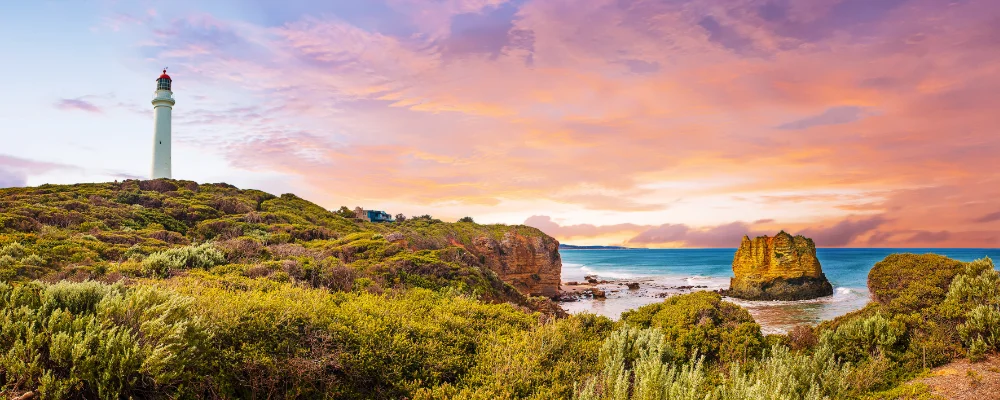
- Cape Otway Lighthouse: first lit in 1848 and the oldest surviving lighthouse on mainland Australia. It’s down a side road through the Great Otway National Park, where koalas are often seen in the trees.
- The Twelve Apostles: limestone stacks up to 50 m high off Port Campbell National Park. There were never twelve. Only nine were ever recorded, and seven still stand after collapses in 2005 and 2009.
- Loch Ard Gorge: 3.5 km west of the Twelve Apostles, named after the clipper Loch Ard, wrecked here on 1 June 1878. Only two of the 54 people on board survived. The stairs down to the beach were closed after rock falls and were due to reopen in October 2026 after repairs; check with Parks Victoria before you go. On the beach, stay behind the fencing below the cliffs.
Distance
About 240 km (150 miles) from Torquay to Allansford. Warrnambool, with the train back to Melbourne, is a few kilometres further on.
If you have a GPX of this route from its official site or a planning app, open it in our free GPX viewer to see the distance, the climb and the height profile. The file stays on your device.
Best time to go
November to April. At Cape Otway, January and February are the driest months, with about 40 to 45 mm of rain and average highs around 21 °C. June to September bring around 18 to 20 days of rain a month, and highs of 13 to 15 °C. The coast can be very windy at any time of year. Check VicEmergency for fire and weather warnings in any month.
More journeys in Australia
- Western Australia · Newluks
- Katoomba tourist! · Greg
- North With Larinda · Chris
- World Trip - One Planet Expedition · David Bossek (Nature Nomad World)
Flyby films from Australia
- Pacific Crossing - Panama To Austra · David Bossek (Nature Nomad World)
- Katoomba! · Greg
- South Bound. · Chris
- Turning Toward Home · Newluks
More routes like this
- Tasmanian Trail by bike · about 480 km (300 miles) · Australia
- Munda Biddi Trail by bike · about 1,070 km (665 miles) · Australia
- Rhine Cycle Route (EuroVelo 15) · about 1,233 km (766 miles) · France, Germany, Netherlands, Switzerland, Austria, Liechtenstein
- Bodensee-Radweg (Lake Constance Cycle Path) · about 263 km (163 miles) · Germany, Austria, Switzerland
- Berlin to Copenhagen cycle route · about 700 km (435 miles) · Germany, Denmark
- La Vélodyssée by bike · 1,300 km (808 miles) · France